
Nail Disorders: Telling Abnormal Nails Apart, From What You See to Possible Conditions
Most people do not see a doctor with a diagnosis in mind. They come with what they can see, such as wavy nails, dark nails, thick yellow nails, or nails lifting off the nail bed. This page is therefore arranged from the symptom you see to the conditions it may point to, so you can start from what you can actually observe on your own nails and then read the article that matches your case.
Nails reflect both local health and general health. Most nail changes are harmless and come from everyday use or ageing, but a few features can be a sign of a condition that needs a prompt diagnosis, so there is a separate red-flag section below.
Symptom table: what you see and what it could be
Start with the leftmost column, find the row that best matches your nails, then read on in the linked article.
What you see | Possible conditions | Read more |
|---|---|---|
Vertical wavy nails: ridges and grooves running from the nail base to the tip, usually on every finger | Age-related change, dry nails (onychorrhexis); less often linked to a disease of the nail base | |
Horizontal wavy nails: deep grooves across the nail, at the same position on several fingers | Beau's lines from a severe illness, high fever, chemotherapy, or inflammation at the nail base | |
Dark nails, or a brown to black streak running lengthwise | Blood under the nail, natural pigmentation, certain medicines, or subungual melanoma | |
Brittle nails that break easily, chip, or peel in layers at the tip | Repeated wetting and drying, cleaning products, acetone, and ageing (onychoschizia) | |
Thickened nails, cloudy yellow or brown, with crumbly debris under the nail | Nail fungus (onychomycosis), which must be confirmed by testing before medication is started | |
Nail separating from the nail bed, with a white gap under the nail | Onycholysis from psoriasis, fungus, repeated trauma, chemicals, or certain medicines | |
Red, swollen, tender skin around the nail, with pus or loss of the nail fold | Acute bacterial paronychia, or chronic paronychia from wet work and fungus | |
Small pinprick-like pits in the nail, possibly with oil-drop spots under the nail | Nail psoriasis is the most common cause, followed by eczema and alopecia areata | |
Toenail edge or corner digging into the flesh, with pain, swelling, and difficulty walking | Ingrown toenail (onychocryptosis) from improper nail trimming and tight shoes |


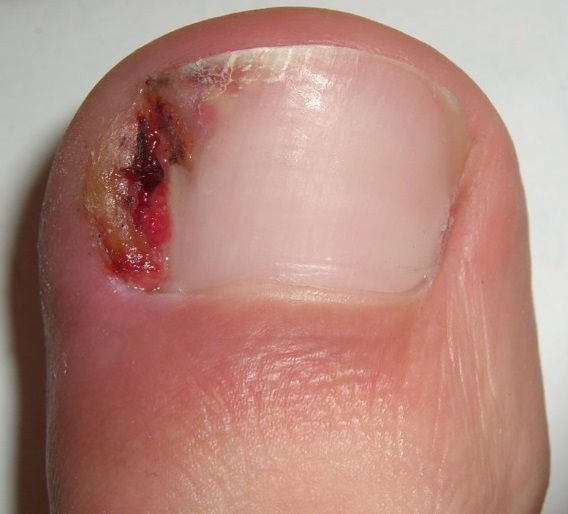
If you have several symptoms at once, start with the most prominent one, and always read the red-flag section below.
When a nail change is a warning sign
Most nail changes are not serious, but the following features should be assessed by a dermatologist promptly, because they must be distinguished from subungual melanoma, which is often diagnosed late because it is mistaken for a bruise from an injury:
A dark lengthwise band on a single nail: especially if the band gradually widens, has uneven colour, has blurred edges, or is wider than about 3 millimetres, and even more so if it is new in an adult with no history of injury.
Hutchinson's sign: pigment spreading from the nail plate onto the skin around the nail or the cuticle is a specific sign and needs prompt further examination.
Destroyed nail plate: a nail that is cracked, distorted, or partly missing, together with a coloured band or a lump under the nail.
A sore or bleeding under the nail that does not heal: especially a chronic sore that does not respond to usual treatment.
One nail that stays abnormal: when only one finger is clearly abnormal with no explanation, it deserves more investigation than when several fingers are affected equally.
In these cases the doctor examines the nail with a magnifying device (onychoscopy) and may consider a biopsy of the nail matrix (nail matrix biopsy) for a definite diagnosis. Waiting a long time to see if it changes is the most common reason for delayed diagnosis. You can read about telling blood under the nail from pigment in the article Dark nails: causes and whether they are dangerous
Common nail disorders, grouped by cause
Group 1: Infections
Nail fungus (onychomycosis) — the most common cause of thick, discoloured nails. The diagnosis must be confirmed before medication is started, because treatment takes many months. For an overview of symptoms and treatment, see the full nail fungus article and the guide to KOH and PAS testing before starting terbinafine.
Paronychia (nail fold infection) — the acute form brings sudden pain, swelling, redness, and pus, while the chronic form is linked to wet work and loss of the skin around the nail; the two are treated differently.
Group 2: Skin diseases that show up in the nails
Nail psoriasis — causes nail pitting, oil-drop spots, onycholysis, and thick debris under the nail; it often occurs together with psoriatic arthritis.
Onycholysis and severity scoring with NAPSI — a systematic approach to confirming and treating nail disease caused by psoriasis.
Scalp rash and nail disease — the nails and scalp are often affected together in several chronic skin diseases.
Group 3: Problems from use and structure
Brittle, easily broken nails — most causes are mechanical and environmental factors, not a vitamin deficiency as is commonly believed.
Wavy nails, vertical and horizontal — the direction of the ridges is the key to telling the causes apart, and horizontal ridges can be used to work back to the event that made the nail stop growing.
Ingrown toenail — most common on the big toe; it can be prevented by trimming nails correctly and choosing shoes that fit well.
Ingrown toenail: preventing recurrence — correcting the misgrowing nail edge is the key to keeping it from coming back.
Group 4: Pigment and tumours
Dark nails and pigmented bands under the nail — covers telling blood under the nail from pigment, the ABCDEF rule, and Hutchinson's sign, which is the group that needs the most caution.
Frequently asked questions
Which nail changes should I see a doctor about quickly? A brown or black lengthwise band on a single nail that keeps widening, pigment that spreads onto the skin around the nail (Hutchinson's sign), a destroyed nail plate together with a lump under the nail, a sore under the nail that does not heal, and a single nail that stays abnormal without explanation. All of these should be assessed promptly by a dermatologist.
Are wavy nails and brittle nails the same condition? No. Wavy nails means the nail surface is uneven, with raised ridges or grooves, caused by uneven nail production at the nail base. Brittle nails break or peel in layers, and the problem lies in the adhesion between keratin layers. The two can occur together, especially in older adults.
Do thick yellow nails always mean fungus? Not always. Nail psoriasis, repeated trauma from shoes, and age-related nail thickening can all make nails thick and discoloured too. This is why the diagnosis should be confirmed with KOH, culture, or PAS staining before starting oral antifungal medication, which takes a long time and requires monitoring of liver function.
Can nail changes really point to an internal disease? In some cases, yes. For example, spoon-shaped nails are linked to iron deficiency, horizontal grooves are linked to a severe past illness, and certain pale nail patterns are linked to liver or chronic kidney disease. However, a nail change alone is not enough for a diagnosis; it must always be assessed together with the history, other symptoms, and further tests.
If you are not sure which group your nails fall into, or they match any of the warning signs, you can consult a dermatologist at Siam Dermatology by phone at +66 61 448 7000 or on LINE @siamderm for a proper diagnosis.
References
DermNet NZ. Nail disorders. https://dermnetnz.org/topics/nail-disorders
DermNet NZ. Melanoma of the nail unit. https://dermnetnz.org/topics/melanoma-of-the-nail-unit
DermNet NZ. Nail psoriasis. https://dermnetnz.org/topics/nail-psoriasis
DermNet NZ. Onycholysis. https://dermnetnz.org/topics/onycholysis
DermNet NZ. Paronychia. https://dermnetnz.org/topics/paronychia
DermNet NZ. Fungal nail infections. https://dermnetnz.org/topics/fungal-nail-infections
American Academy of Dermatology. Tips for healthy nails. https://www.aad.org/public/everyday-care/nail-care-secrets/basics/healthy-nail-tips
UpToDate. Overview of nail disorders. https://www.uptodate.com/contents/overview-of-nail-disorders
Levit EK, Kagen MH, Scher RK, et al. The ABC rule for clinical detection of subungual melanoma. J Am Acad Dermatol. 2000;42(2 Pt 1):269-274.
Bolognia JL, Schaffer JV, Cerroni L, eds. Dermatology. 4th ed. Elsevier; 2018. Nail Disorders chapter.
Written by Dr. Patara Voravutinon, Dermatologist · Last reviewed July 30, 2026

Comments