
What Does a Cancerous Mole Look Like, and Which Moles Are Risky?
Updated: 1 day ago
Written by นพ. ภัทร วรวุทธินนท์, dermatologist
A cancerous mole, or melanoma, is a cancer of the pigment-making cells in the skin. Most moles are ordinary and not dangerous, but early melanoma can look like a common mole. It helps to know which moles are risky by using the ABCDE rule and by noticing a mole that looks different from the others. A new mole, a mole that is getting bigger, a change in colour, a sore, bleeding or unusual itching are reasons to see a dermatologist.
This page is a refresh of the clinic’s existing mole-and-skin-cancer article. The original URL is unchanged. It explains how a cancerous mole can look, how to check your skin, and how a dermatologist uses a dermoscope and, when needed, a biopsy.
What is a cancerous mole (melanoma)?
A cancerous mole (melanoma) is a cancer of melanocytes, the cells that give skin and moles their colour. An ordinary mole is a harmless cluster of these cells. Melanoma appears when those cells grow in an uncontrolled way and, if left, may go deeper or spread.
Melanoma can start on skin that looks normal, or in a mole that was already there. Dermatology references note that most melanomas arise on apparently normal skin, not from every existing mole. The everyday phrase “cancerous mole” usually refers to melanoma, not to moles in general.
Other skin cancers, such as basal cell and squamous cell carcinoma, have a different origin and are managed differently. This article focuses on melanoma.
Risk can be higher if you have many moles, atypical (dysplastic) moles, a close family history of melanoma, skin that burns easily, a history of blistering sunburn, ultraviolet light from the sun or tanning beds, or a weakened immune system. People of every skin colour can get melanoma. In Asian patients, it is especially important to check the palms, soles and nails, because when melanoma occurs it is more often found in these places than the types linked to sun-exposed skin. See also what causes moles (in Thai) and atypical moles (in Thai).
What does a cancerous mole look like? The ABCDE rule and the odd mole out
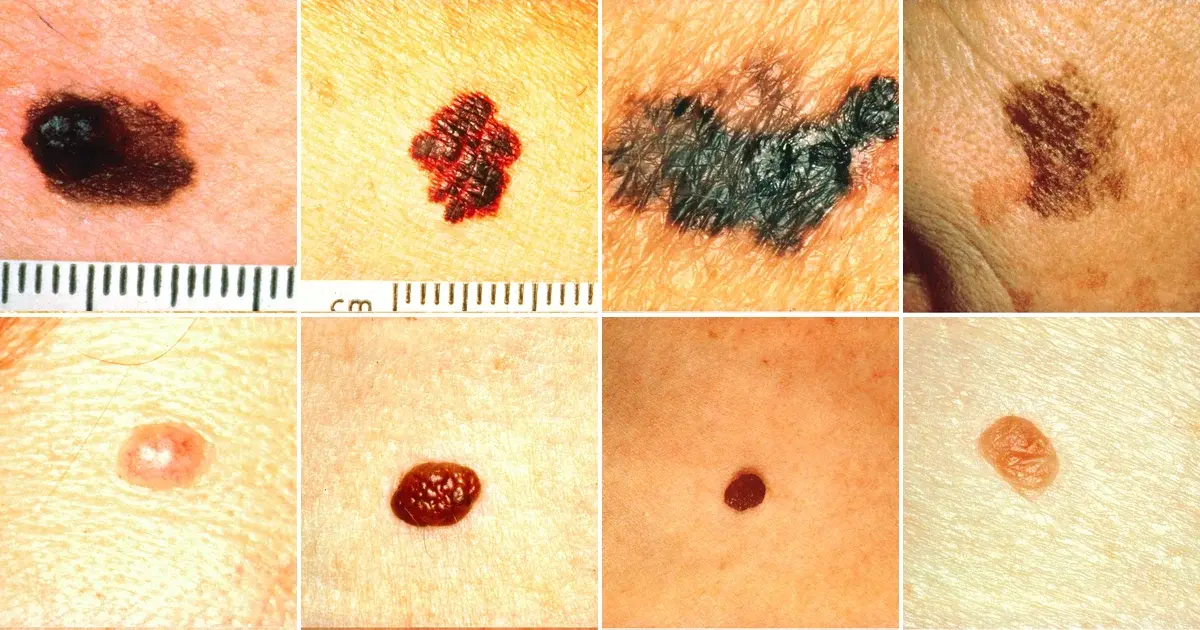
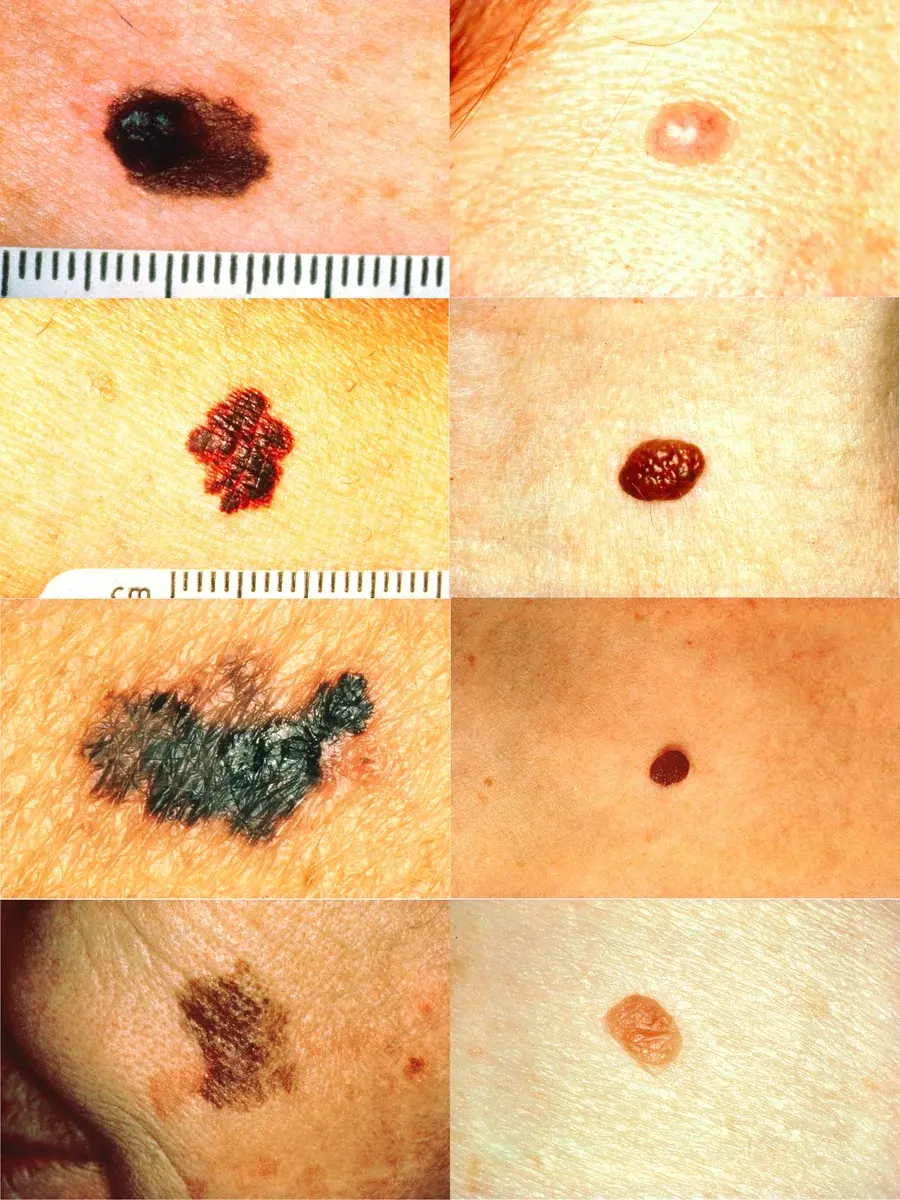
A cancerous mole is often asymmetric, has an uneven border, more than one colour, is getting larger, or is changing, and it may look different from your other moles. The ABCDE rule is a practical checklist. A concerning mole does not have to show every letter.
Letter | Meaning | What to look for |
A Asymmetry | The two halves do not match | If you imagine a line through the middle, the sides look different |
B Border | The edge is uneven, notched or poorly defined | A typical mole usually has a smoother, clearer edge |
C Colour | The colour is uneven, or several colours sit in one mole | Brown, tan and black, and sometimes red, white or blue |
D Diameter | Often more than about 6 millimetres when found | About the size of a pencil eraser is a warning, but melanoma can be smaller |
E Evolving | A change in size, shape, colour, thickness, or new symptoms | Growing, itching, crusting, bleeding, or looking unlike nearby moles |
There is also the “ugly duckling” idea: most moles on the same person look alike. A mole that stands out, whether larger, smaller, darker, lighter or isolated, should be checked. Symptoms of a concerning mole are often a change in how it looks, not pain.
A typical mole is usually round or oval, with a fairly clear border, fairly even colour, and a stable appearance over time. Some harmless moles have hair or become raised. A change in colour or size, or new itching, pain, bleeding or inflammation, is a reason to have it assessed. Spots that look like moles may instead be seborrhoeic keratoses (in Thai) or seborrhoeic keratoses (skin barnacles) (in Thai). A dermatologist can tell these apart more reliably.
Checklist: which moles are risky, and when to see a doctor
A risky mole, or any new, changing or unusual spot, should be checked by a dermatologist without long delay. You do not need every ABCDE feature, and you do not need to wait months to see whether it settles by itself.
See a dermatologist if any of the following apply:
The mole is asymmetric, has an uneven border, several colours, or is clearly getting larger
A previously stable mole changes shape or colour, becomes raised, or grows quickly
A mole or spot itches, forms a crust, bleeds, swells or ulcerates
A sore has not healed within a few weeks
A mole looks different from the other moles on your body
A new mole appears in adulthood, especially if it looks unusual
A dark streak or patch appears on a nail, palm or sole without a clear injury
You have many moles, atypical moles, or a family history of skin cancer, and one mole has changed
This checklist helps you decide to book a visit. It is not a diagnosis. Many spots that meet these points are still not melanoma, but an early examination gives a clearer answer than watching and waiting for too long.
Is a new mole, or a mole that is getting bigger, dangerous?
A new mole is not always cancer, and a mole that is getting bigger is not always cancer. A new mole that looks unusual, or an old mole that is growing or changing colour or shape, should be checked.
New moles form when pigment cells cluster. They often appear in childhood and may still appear until around the age of 40. After that, a new mole, or one that looks different from the others, should be seen by a dermatologist. Melanoma may start as a new spot on otherwise normal skin, or in a mole that begins to change.
Ask yourself whether the spot was there before, whether it has grown over weeks to months, and whether it looks different from your other moles. If the answers worry you, do not burn, laser or use a removal product on it yourself. Have it assessed first. More on what causes moles (in Thai).
Moles under a nail, a dark nail streak, and spots on the palms or soles
Dark spots under a nail, a dark streak in a nail, and uneven patches on the palms or soles are easy to miss, but they matter in Asian patients. When melanoma occurs, the type found on the palms, soles and under the nails (acral lentiginous melanoma) makes up a larger share of melanomas in people with darker skin and in Asian populations. That does not mean melanoma is more common overall in Asian people. It means a mole check should include these sites, not only sun-exposed skin.
A dark nail streak that should be checked is a brown or black band running the length of the nail, especially if it is widening, uneven in colour, has edges that are not parallel, is distorting the nail, or if pigment spreads onto the skin of the nail fold (Hutchinson sign). A slowly enlarging, uneven or ulcerated patch on the sole or heel should be checked too.
Not every dark nail is cancer. Blood under the nail after an injury is common; it often fades or grows out with the nail. See what causes a dark nail (in Thai). If there was no injury, the band is widening, or colour has spread onto the surrounding skin, book a dermatologist visit.
Sunlight is not the main factor for this type of melanoma in the way it is for many other types. “I rarely sunbathe” is not a reason to skip the soles of the feet. A monthly self-check should include palms, soles, the spaces between the toes, and the fingernails and toenails.
Can a red mole be cancer?
Most red moles are not cancer. They are often cherry angiomas, which are common blood-vessel growths, especially later in adult life, and are generally harmless. Worry about a “red mole” and cancer usually starts when someone notices a new red dot.
There is, however, a less common form of melanoma with little or no brown-black pigment (amelanotic melanoma). It may look pink, red, skin-coloured or pale. A red spot that grows quickly, bleeds easily, has an uneven edge, or looks different from your other red spots should be examined with a dermoscope. Colour alone is not enough to decide. See our article on cherry angiomas (in Thai).
How does a dermatologist examine a mole?
A dermatologist looks at the mole with the naked eye, asks how it has changed, and uses a dermoscope, a magnifying instrument that shows structures beneath the surface. If the spot is still concerning, the usual next step is to remove tissue and send it for pathology, rather than relying on appearance alone.

ภาพ: Frank33 · CC BY-SA 3.0 · ตัดต่อ
At คลินิกเฉพาะทางผิวหนัง Siam Dermatology, the first priority is a correct diagnosis. The doctor examines the mole by eye and with a dermoscope and, when indicated, can take a sample for pathology. If the result is melanoma or another skin cancer, care is planned according to the type, stage and depth. Surgery with an appropriate margin is the usual first approach in early disease. Some people need further care or a referral. Results differ from person to person. This article describes a general approach; it does not list every procedure the clinic offers.
Finding a melanoma earlier often means more treatment options. No approach can promise the same outcome for everyone.
Can a suspicious mole be burned or lasered off?
A suspicious mole should not be burned, lasered or destroyed with a removal product before it is diagnosed. That can destroy the tissue needed for pathology and delay the diagnosis. The standard is an assessment by a dermatologist, then an excision for laboratory testing when it is indicated.
Removing a mole at home, or having it burned off in a beauty salon without an examination, risks infection, scarring and a missed diagnosis. Most moles are not cancer, but a risky-looking mole should be examined under a microscope before it is destroyed. Moles that have been assessed as unlikely to be cancer can then be removed in a suitable way if needed. See mole removal (in Thai).
How to check your moles every month
A monthly head-to-toe skin check makes it easier to notice a new mole or a change. Look at sun-exposed skin and at places that are easy to miss: the scalp, back, palms, soles, spaces between the toes, and the nails.
A simple routine at home:
Stand in front of a full-length mirror. Check the front, back and both sides, and lift your arms to see the underarms
Check the forearms, palms, spaces between the fingers, and fingernails
Check the legs, the backs of the legs, the soles, the spaces between the toes, and the toenails
Use a hand mirror, or ask someone at home to help you check the scalp, neck, back and buttocks
Photograph or note any mole you are unsure about, so you can compare it the next month
If you find something new, changing or unusual, book a dermatologist visit rather than waiting for the next routine check. Self-examination is a first step in watching your skin. People with many moles, atypical moles, a family history of skin cancer, or a previous skin cancer may need more frequent professional checks, as advised by their doctor.
You can lower the risk of the types of melanoma linked to ultraviolet light by avoiding strong sun, covering up, using sunscreen and not using tanning beds. Sun protection alone does not replace checking the palms, soles and nails.
Frequently asked questions about cancerous moles
Does a cancerous mole hurt?
A cancerous mole often does not hurt, especially early on, so the absence of pain does not mean a mole is safe. Some people notice pain or unusual tenderness, but a painful mole can also have other causes. What matters more is whether it fits the ABCDE rule or is changing. If a mole hurts and does not settle, or if it bleeds, see a dermatologist.
Does a cancerous mole itch?
Some cancerous moles itch, many never itch, and most itchy spots are not cancer. Itching alone cannot confirm or rule out melanoma. The concern is an itchy mole that is also new, changing, uneven, many-coloured, or different from your other moles.
Can a cancerous mole be treated?
When melanoma is found early, the usual first step is surgery with an appropriate margin. Treatment options are often more straightforward if it is found sooner, but the outcome depends on the type, depth, stage and a person’s overall health. More advanced disease may need a more complex plan. No method can promise the same result for everyone.
Can children get a cancerous mole?
Melanoma is very uncommon in children, especially young children. Most childhood moles are ordinary and not dangerous. A mole or spot that grows quickly, changes colour, forms a sore, bleeds, or looks different from the others should still be checked. Children do not need every mole removed.
Where can I get a cancerous mole checked?
See a dermatologist who can use a dermoscope and, when indicated, take a sample for pathology. At คลินิกเฉพาะทางผิวหนัง Siam Dermatology in Samut Prakan, moles are assessed by eye and with a dermoscope, and tissue can be sent for testing when needed. Book via LINE @siamderm or call 061-448-7000.
Is a raised mole dangerous?
Most raised moles are not dangerous, and ordinary moles can become more raised over time, especially if they sit deeper in the skin. A mole that was flat and then becomes raised quickly, feels firm, keeps growing, has uneven colour, bleeds, or looks different from the others should be checked, because some melanomas can form a raised lump. Being raised, on its own, is not enough to decide.
Do all moles need to be removed?
No. Typical moles that are stable and have no concerning features can usually be watched. Removal is considered when a mole looks suspicious and needs pathology, or after a dermatologist has assessed it and removal is appropriate because of rubbing or because the person wants it removed once it is unlikely to be cancer. Destroying a mole before it is assessed can delay a diagnosis.
See a dermatologist at คลินิกเฉพาะทางผิวหนัง Siam Dermatology
If you are worried about a cancerous mole, a mole that is changing, or you would like a mole check, you can see a dermatologist at คลินิกเฉพาะทางผิวหนัง Siam Dermatology. The doctor will take a history, examine the mole by eye and with a dermoscope, and consider a biopsy when it is indicated. More details: general dermatology care (in Thai)
Book via LINE @siamderm or call 061-448-7000 (+66 61 448 7000)
Hours: Monday–Friday 16:00–20:00 and Saturday–Sunday 08:00–16:00
Wednesday: no dermatology OPD (laser and skin surgery open)
References
American Academy of Dermatology. What to look for: ABCDEs of melanoma
American Academy of Dermatology. Find skin cancer: How to perform a skin self-exam (15 May 2023)
American Academy of Dermatology. Moles: Diagnosis and treatment
Skin Cancer Foundation. Melanoma warning signs and images (updated October 2026)
Mayo Clinic. Melanoma: Symptoms and causes (29 September 2026)
National Cancer Institute. Melanoma Treatment (PDQ) – Patient Version
Comments