
Cellulitis: What It Is, Causes, Symptoms and Proper Treatment
Updated: 23 hours ago
Cellulitis is a bacterial infection of the dermis and the fat layer beneath the skin. The area becomes red, warm, swollen and tender, and the edge of the redness is usually poorly defined. It most often affects one leg. The usual culprits are Streptococcus and Staphylococcus aureus. The main treatment is antibiotics, not cutting the skin to drain pus, because cellulitis has no pocket of pus to drain.
"Yesterday it was just a red spot, and today it has spread over half my shin." This speed of spread is what separates cellulitis from an ordinary allergic rash, and it is why this article focuses on two things in particular: how to tell it apart from other conditions and when you need to go to the hospital tonight, not tomorrow morning.
What Is Cellulitis?
Cellulitis is a bacterial infection of the dermis and the subcutaneous tissue (the fat layer under the skin). The area becomes red, warm, swollen and tender, and the edge of the redness is usually poorly defined, gradually fading into normal skin.
The key points that make this more than an "ordinary rash" are:
The bacteria sit deeper than an allergic rash or a fungal rash, so creams do not work. It needs oral antimicrobials, or intravenous ones.
The infection can spread through the tissue layers into the lymphatic system and the bloodstream.
It almost always affects just one side of the body. If both legs are red and swollen at the same time, the cause is usually not cellulitis.
How Is Cellulitis Pronounced, and What Is It Called in Thai?
Cellulitis is pronounced "sel-yoo-LY-tis". In Thai medical language it is called neua-yuea-ak-seb (literally "inflamed tissue") or sel neua-yuea-ak-seb, and it is sometimes described as a bacterial skin infection. Its ICD-10 code falls in the L03 group.
Note that the medical term cellulitis is completely unrelated to cellulite, the dimpled "orange peel" skin on the thighs and hips. The two words are spelled almost the same, but they are entirely different things.
What Causes Cellulitis? Common Bacteria
Most cases are caused by bacteria that normally live on our skin but get into a deeper layer than where they belong.
Group A Streptococcus: the main cause of redness that spreads quickly over a wide area, often with a fever.
Staphylococcus aureus: common when there is an obvious wound, pus or an abscess.
MRSA (methicillin-resistant Staphylococcus): needs to be considered in people who were recently hospitalized, have had a resistant infection before, or did not improve on standard treatment.
Other bacteria in specific situations: for example wounds exposed to seawater or brackish water, animal bites, or people with weakened immunity. In these cases the bacteria are different, and so is the choice of drug.
The information your doctor most wants from you is therefore not just "how many days it has been red" but "what wound you had beforehand, what you were exposed to, and where you have been."
The Most Overlooked "Entry Point" for Bacteria
Bacteria do not pass through normal skin by themselves. They need a break to get in, and that break is often so small that patients do not notice it.
Athlete's foot and fungal infection between the toes: this is the most common entry point for cellulitis of the leg. Soggy, cracked skin between the toes is an ideal doorway for bacteria, which is why treating foot fungus is part of preventing cellulitis.
Cracked heels and dry, peeling skin, especially in older adults and people with diabetes.
Small scrapes, knife cuts, and insect bites that were scratched open.
Surgical wounds, piercings and tattoos.
Chronic inflammatory skin conditions such as atopic dermatitis or psoriasis, where the skin cracks into fissures.
Chronic lymphedema, which makes the skin break easily and also weakens the local immune defense.
Who Is at Higher Risk of Cellulitis Than Other People?
People with diabetes, especially when blood sugar is poorly controlled.
People with chronic leg swelling, varicose veins, or a history of lymph node removal surgery.
People who are overweight.
People with low immunity, for example those taking immunosuppressants or long-term steroids, or undergoing cancer treatment.
Older adults, whose skin is thin and dry.
People who have had cellulitis before. This one is very important, because the earlier infection damaged the lymphatic channels in that area, so it can come back in the same place.
Symptoms of Cellulitis: 5 Things to Look For
Red: a patch with indistinct edges that gradually fades into normal skin.
Warm: when you touch it with the back of your hand and compare it with the neighboring skin, it feels clearly warmer.
Swollen: the skin is tight and shiny. In some people the swelling is enough to make the hair follicles look pitted, like orange peel.
Painful: tender to touch, and often painful all the time even when not pressed.
Growing: this is the sign that best separates the condition from an ordinary rash. The redness is not the same size today as yesterday.
Associated symptoms can include fever, chills, fatigue, and swollen lymph nodes in the groin or armpit on the same side. Some people see red streaks running up along the lymphatic channels, which means the infection is already spreading through the lymphatic system.
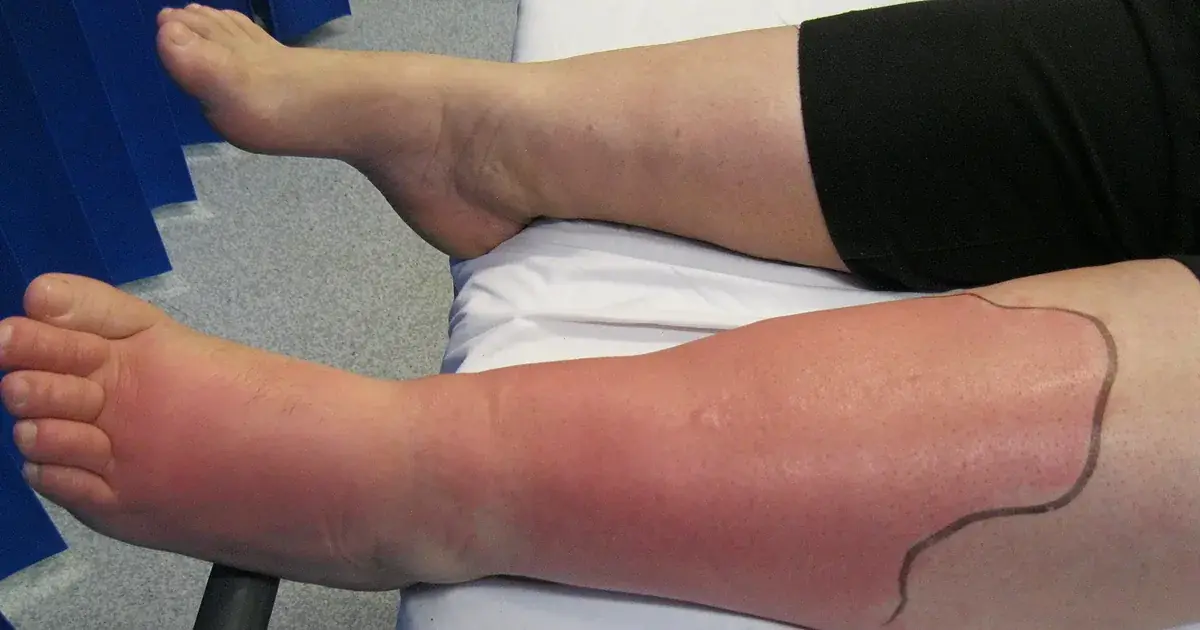
A practical tip you can use at home: use a ballpoint pen to draw a line along the edge of the redness and write down the time. This lets you and your doctor see clearly how far the redness has spread over the next 12 to 24 hours, which is very valuable information for treatment decisions.
Common Locations: Legs, Feet, Face and Around the Eyes

Image: cbinrva · CC BY-SA 4.0 · cropped
The legs and feet are the most common location, because gravity, swelling and fungal infection between the toes all come together there.
Locations that need particular care are
Around the eyes: it is necessary to tell inflammation in front of the orbital septum apart from inflammation inside the eye socket (orbital cellulitis). The latter is an eye emergency. If there is a bulging eye, pain when moving the eye, double vision, or worsening vision, go to the hospital immediately.
Face and ears: it spreads quickly and sits close to important structures.
Hands: they are close to the tendon sheaths, and infection can travel along the sheaths quickly and may need surgery.
Telling Cellulitis Apart from Look-Alike Conditions
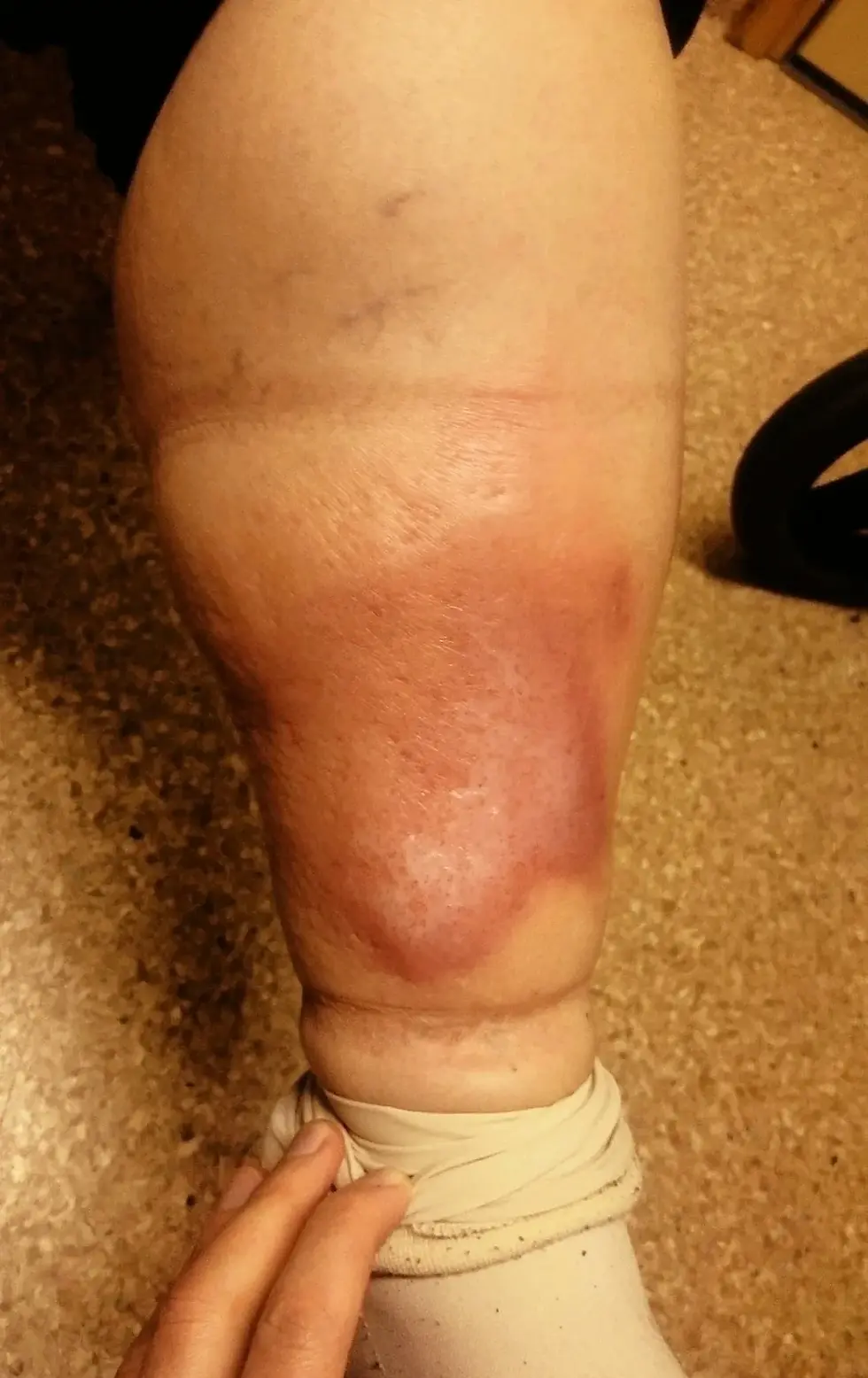
Studies have found that a fair number of conditions diagnosed as cellulitis are actually something else. Telling them apart matters a great deal, because if the diagnosis is wrong, the patient receives antibiotics they do not need and the real problem goes untreated.
Erysipelas: a more superficial infection. Its hallmark is a sharply defined, raised edge that you can feel, unlike cellulitis, which has a fuzzy edge. A high fever often comes before the rash. For details on telling the two apart, read Cellulitis vs Erysipelas: How to Tell the Difference and How to Treat Them.
Stasis dermatitis: this is the most common impostor. It is usually on both sides, itchy, with flaky skin, long-standing dark discoloration, and no fever.
Deep vein thrombosis (DVT): swelling on one side with a tight, aching calf, but usually not as red or as warm. It must be ruled out because the danger is of a different kind.
Gout and arthritis: also red, hot and swollen, but the pain is centered on the joint and is severe when the joint moves.
Contact dermatitis: the main symptom is itching, not pain. There are often tiny blisters, and the borders match whatever touched the skin.
Insect bite reactions: there is a clear central spot, it is itchy, and it does not keep spreading after 48 hours.
A simple rule that always works: "more pain than itch + one side + spreading every day + fever" leans toward infection, while "more itch than pain + both sides + present for months" leans toward something other than infection.
Danger Signs: Go to the Emergency Room Immediately
The most frightening condition is severe necrotizing fasciitis (infection of the fascia layer), which the media call "flesh-eating bacteria." At first it looks like ordinary cellulitis, but it progresses much faster and needs urgent surgery. The signs that mean you should go to the hospital tonight, not tomorrow, are:
Pain far more severe than the skin looks: this is the single most important warning sign.
Redness spreading so fast that you can see it change within a few hours.
The skin turns dark, purple or gray, or develops large blisters or blood-filled blisters.
The skin in the area starts to go numb or loses sensation.
Pressing on it feels like crackling bubbles under the skin.
High fever, chills, confusion, low blood pressure, or passing very little urine.
Symptoms on the face or around the eyes, or in a person with low immunity.
Still getting worse after a full 48 to 72 hours of antibiotics.
How Doctors Diagnose Cellulitis
Diagnosis relies mainly on the history and physical examination. No single test confirms it with complete certainty. What the doctor does is
Ask about wounds, travel, animal bites, underlying conditions and current medications.
Look for the entry point of the bacteria, especially between the toes, which patients often do not mention themselves.
Mark the edge of the redness to track spread.
Run blood tests in people with fever or whole-body symptoms.
Culture pus or wound fluid, if there is pus that can be collected.
Order an ultrasound when an abscess underneath is suspected, or when deep vein thrombosis needs to be ruled out.
Order advanced imaging when a deep infection or bone infection is suspected.
How Is Cellulitis Treated, and Which Drugs Are Used?
The heart of treatment is antimicrobial drugs that cover Streptococcus and Staphylococcus, together with care of other contributing factors.
When there is no pus, the drug chosen usually covers Streptococcus first and foremost.
When there is pus, an abscess or an obvious wound, Staphylococcus must be covered as well, and if there is an abscess, drainage is just as important as the drug. An abscess that is not drained usually does not respond to medication alone.
When there are risk factors for resistant bacteria, the doctor will choose a drug class that covers MRSA.
The usual duration is about 5 to 7 days for uncomplicated cases that respond well, and it may be longer for severe cases, people with low immunity, or slow improvement.
Something that greatly improves treatment but is often neglected is raising the leg above the level of the heart, because it directly reduces swelling and skin tension.
Important: this article does not name specific drugs or doses, because the choice of antibiotic depends on the location, severity, drug allergy history, kidney function, and local patterns of antibiotic resistance. Leftover antibiotics from a previous illness or ones bought on your own often do not match the bacteria, and not finishing the full course is one of the causes of resistant bacteria.
When Do You Need to Be Admitted to the Hospital for Intravenous Drugs?
Clear whole-body symptoms, such as high fever, rapid pulse, or low blood pressure.
A very wide area of involvement, or fast spreading even after starting medication.
A suspected deep infection that needs surgery.
High-risk locations, such as inside the eye socket, the face, or the hands.
People with low immunity, or with underlying conditions that are not well controlled.
Unable to take oral medication, vomiting, or no caregiver at home to monitor symptoms.
How Many Days Until It Improves on Medication, and Why Can Day One Look Worse?
This question worries patients the most, and the answer is often not what they expect.
In the first 24 to 48 hours after starting medication, the redness may look slightly larger or more intense even though the drug is working, because the dying bacteria release substances that stimulate inflammation. So what should be used to judge whether the drug is really working is not the size of the redness, but
The fever starting to come down.
The pain easing.
The overall feeling of tiredness improving.
Generally, whole-body symptoms begin to improve within 48 to 72 hours, while the redness and swelling gradually fade over several days to 1 to 2 weeks, and post-inflammatory dark marks can last for several weeks after the infection has fully cleared, which does not mean the infection is still there.
But if a full 48 to 72 hours have passed and you still have a fever, the pain is getting worse, or the redness keeps spreading, you need to go back to the doctor to review the diagnosis and the choice of drug, rather than continue to wait on your own.
Taking Care of Yourself at Home During Treatment
Take the medicine for the full course the doctor prescribed, even after you feel better.
Keep the affected area elevated as much as you can throughout the day.
Mark the edge of the redness and note the time, and take photos to compare.
Apply a gentle cold compress to ease the pain, but do not apply a hot compress to severely inflamed skin.
Clean the wound with clean water or saline and cover it properly.
Do not apply steroid cream on your own to an area that may be infected, because it temporarily makes the redness look better while the infection keeps spreading underneath.
Do not squeeze or puncture it yourself. If there is a pus-filled lump, let a doctor drain it.
Can Cellulitis Go Away on Its Own?
A small patch of redness around a fresh scrape is sometimes just the body's inflammatory response and can go away on its own. But once cellulitis has been diagnosed, you should not wait for it to go away on its own, because infection in the deeper layers tends to spread rather than settle, and the complications that follow include abscesses, bloodstream infection, infection spreading down to the bone, and damage to the lymphatic channels that causes permanent chronic leg swelling.
Why Do Some People Get It Again and Again?
Some patients come back with it in the same place, and it is often because these two things have not been fixed.
The entry point is still there, especially fungal infection between the toes and cracked skin that has not been treated.
Lymphatic drainage in the area was damaged by the earlier infection, so swelling comes more easily, and the more swelling there is, the easier it is to get infected, which becomes a cycle.
Good treatment therefore does not end when the antibiotics run out. It has to go back and close the entry point and manage the swelling too.
How to Prevent a Recurrence
Treat foot fungus and fungus between the toes until it is truly gone, and dry between the toes thoroughly after every shower.
Moisturize the legs and feet regularly so the skin does not crack into fissures.
Manage leg swelling by elevating the legs, and by using compression stockings as your doctor advises in suitable cases.
Trim your toenails carefully and do not cut them down to the nail fold.
Wear shoes that do not rub and avoid walking barefoot in risky places.
Control diabetes and body weight.
Clean every new wound immediately, even a small one.
For people who have very frequent recurrences even after the factors above have been addressed, there are approaches that use long-term preventive antibiotics, which must be considered case by case by a doctor only.
Common Misunderstandings
"Spreading redness means the drug is not working": not always. In the first 48 hours the redness can enlarge even though the drug is working. Look mainly at the fever and the pain.
"Red, swollen legs on both sides means cellulitis": generally not. Both sides at once is usually stasis dermatitis or swelling from another cause.
"Once you have it, a topical antibiotic is enough": topical drugs do not soak down to the layer where the bacteria are.
"Once it has healed, you don't need to do anything more": if the entry point for the bacteria is not closed, the chance of recurrence is high.
"Cellulitis is the cellulite on the thighs": they are completely different conditions.
When Should You See a Dermatologist?
See a doctor when you have a red patch that is warm, painful and getting bigger within one to two days, especially when there is a fever, an underlying condition such as diabetes or low immunity, symptoms on the face or around the eyes, or you have had cellulitis before.
A dermatologist plays two additional important roles: telling apart conditions that look similar but are not infections, to reduce unnecessary antibiotic use, and finding and treating the entry point of the bacteria so it does not come back.
You can consult the Siam Dermatology dermatology team on LINE at @siamderm
Frequently Asked Questions About Cellulitis
What is cellulitis, and how is it pronounced?
Cellulitis is pronounced "sel-yoo-LY-tis". In Thai it is called neua-yuea-ak-seb (literally "inflamed tissue"). It is a bacterial infection of the dermis and the fat layer under the skin, making the area red, warm, swollen and tender, with an indistinct edge, and it usually affects one side only. It is unrelated to cellulite, which refers to orange-peel skin.
What causes cellulitis?
Most cases are caused by Group A Streptococcus and Staphylococcus aureus entering the deeper layers of skin through a break in the skin. The most common entry points are fungal infection between the toes and athlete's foot, followed by scrapes, dry cracked skin, surgical wounds, and insect bites that were scratched open.
How is cellulitis treated, and how many days of medication are needed?
It needs oral or injected antimicrobial drugs depending on severity. For uncomplicated cases it usually takes about 5 to 7 days, and longer for severe cases or people with low immunity. If there is an abscess, it also has to be drained. The choice of drug must be made by a doctor, because it depends on the location, severity, drug allergy history, and local patterns of antibiotic resistance.
How many days on medication until the redness fades, and why does it look worse on the first day?
In the first 24 to 48 hours the redness may enlarge or look redder even though the drug is working, because the dying bacteria release substances that stimulate inflammation. Look at the fever and the pain instead, which usually start to improve within 48 to 72 hours. The redness fades over several days to 2 weeks. If it has been a full 72 hours and things are still getting worse, go back to the doctor.
Can cellulitis go away on its own, and how dangerous is it?
Once it has been diagnosed, you should not wait for it to go away on its own, because it tends to spread rather than settle. Complications include abscesses, bloodstream infection, infection spreading to the bone, and damage to the lymphatic channels leading to chronic leg swelling. The signs that mean you should go to the emergency room immediately are pain far more severe than the skin looks, dark or purple skin, large blisters, numbness, or a high fever together with low blood pressure.
Why do some people get cellulitis again and again in the same place?
Because two factors have not been fixed: an entry point for the bacteria that is still there, such as fungus between the toes and cracked skin, and lymphatic drainage that was damaged by the earlier infection, which makes swelling and repeat infection easier. Prevention therefore means treating foot fungus until it is truly gone, moisturizing the skin so it does not crack, and managing leg swelling.
This article provides information for general understanding and cannot replace diagnosis and treatment by a doctor. If you suspect cellulitis, see a doctor for an assessment as soon as possible.
Written by Dr. Patara Voravutinon, Dermatologist · Last reviewed August 30, 2026
Comments