
Psoriatic Arthritis: What Causes It? A Dermatologist Explains the Warning Signs to Check Before Permanent Joint Damage
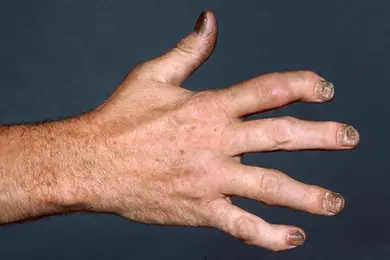
Psoriatic arthritis, sometimes called "psoriasis in the joints" in Thailand, is a chronic, immune-driven joint inflammation that occurs together with the skin disease psoriasis. It affects roughly 1 in 5 to 1 in 3 people with psoriasis. What most patients do not realize is that skin symptoms often appear first, years before joint symptoms. People with psoriasis are therefore an at-risk group who should know the warning signs of this condition in advance.
Most importantly, if psoriatic arthritis is left untreated, it can lead to permanent joint damage, deformity and disability. But when it is found and treated early, the disease can be well controlled and joint damage can be prevented. In this article, a dermatologist explains which symptoms are warning signs, how to tell it apart from other joint diseases, and why people with psoriasis who start having joint pain should not ignore it.
What Is Psoriatic Arthritis, and Why Should People with Psoriasis Know About It?
Psoriasis is not just a skin disease. It is a disease of the immune system throughout the body. The same chronic inflammation that causes thick, scaly patches on the skin can also affect the joints and tendons. When that happens, it is called psoriatic arthritis.
This disease is often overlooked because patients and the people around them focus on the skin rash and do not connect gradually developing joint pain to the "same disease." Many people seek treatment for joint pain separately without telling the doctor that they have psoriasis, which delays diagnosis.
Because dermatologists are often the ones who care for people with psoriasis from the start and over the long term, we are in the best position to notice joint warning signs and refer you to a rheumatologist in time. This is why, if you have psoriasis and begin to have joint pain, you should always tell your dermatologist.
What Causes Psoriatic Arthritis, and Who Is at Risk?
The main cause is an overactive, abnormal immune system that triggers inflammation in the joints, tendons and the points where tendons attach to bone, together with genetic factors and environmental triggers. Common risk factors include:
Already having psoriasis, especially severe psoriasis or patches on the scalp and in skin folds
Psoriasis of the nails — nail pitting or nails separating from the nail bed is clearly associated with psoriatic arthritis
A family history of psoriasis or psoriatic arthritis
Triggers such as being overweight, smoking, joint injury or infection
Joint symptoms most often begin between about 30 and 50 years of age and usually follow the skin rash by many years. In a minority of patients, however, joint symptoms come before the rash or appear at the same time.
Warning Signs of Psoriatic Arthritis That Need Prompt Evaluation
This is the most important section, because catching the signs early is the key to preventing joint damage. The main symptoms to be suspicious of are:
A whole finger swollen like a sausage (dactylitis) — not just the joint, but the entire finger or toe is swollen, which is characteristic of this disease
Pain at the heel, Achilles tendon or sole of the foot (enthesitis) — inflammation where tendons attach to bone, often mistaken for plantar fasciitis
Inflammatory lower back pain — severe stiffness in the morning or after resting for a long time, improving with movement (unlike mechanical back pain, which gets worse the more you move)
Asymmetric arthritis — usually one joint or a few joints, often affecting the fingertip joints (DIP), which is a point of difference from rheumatoid arthritis
Morning stiffness lasting longer than 30 minutes before gradually improving during the day
Nail changes — pitting, nails separating from the nail bed or thickened nails, which are important clues (read our article on "nail fungus" to tell psoriatic nails apart from nail fungus)
If you have psoriasis and these symptoms, especially pain together with swelling and morning stiffness, you should see a doctor for evaluation. Do not wait until the joints become deformed.
Psoriatic Arthritis vs Gout vs Rheumatoid Arthritis — How to Tell Them Apart
People with psoriasis who have joint pain do not always have psoriatic arthritis. They may have another joint disease, and these can occur together. Telling them apart therefore requires a doctor, but the basic principles are as follows:
Psoriatic arthritis — inflammatory pain and swelling, morning stiffness, often asymmetric, affecting the fingertip joints, with sausage-like finger swelling and tendon inflammation, and usually accompanied by psoriasis of the skin or nails
Gout — usually sudden, severe pain in a single joint, with intense swelling, redness and heat, especially at the base of the big toe, and linked to high uric acid. People with psoriasis are more likely than the general population to develop gout
Rheumatoid arthritis — usually inflames the joints symmetrically on both sides, affecting the knuckles and wrists, rarely the fingertip joints, and blood tests often show RF/anti-CCP, unlike psoriatic arthritis, where these are usually not found
Osteoarthritis — mechanical pain that gets worse with use and improves with rest, with morning stiffness lasting only briefly, no more than 30 minutes, and usually without obvious swelling, redness or inflammation
The key rough distinction is that "inflammatory" pain (long morning stiffness, improves with movement, with swelling) differs from "mechanical/degenerative" pain (gets worse with movement, improves with rest). A definite diagnosis requires a physical examination, X-rays and blood tests by a doctor.
Why You Should Treat It Early — The Window Before Permanent Joint Damage
Psoriatic arthritis is a disease in which inflammation steadily erodes the joints. If left uncontrolled for a long time, joints can be permanently damaged and deformed. In severe cases, arthritis mutilans can occur, making it difficult to use the hands or walk. Damage that has already occurred usually cannot be reversed.
Research shows that diagnosis and starting treatment in the early stage of the disease give clearly better long-term outcomes than late treatment. This is why we insist that joint pain in a person with psoriasis is not a minor problem to put up with, but something that should be evaluated by a doctor promptly.
How Dermatologists Are Involved in Psoriatic Arthritis
Many people think joints are only the job of a rheumatologist. That is true in terms of joint care, but dermatologists play an important role in the overall picture:
The first line for spotting signs — because we already care for psoriasis rashes and nails, we can help screen for joint symptoms and refer you quickly
Nails and rashes are clues — psoriasis of the nails and scalp is associated with the risk of arthritis, so assessing the skin and nails is valuable
Some medicines control both skin and joints — many medicines used for severe psoriasis, such as methotrexate and newer biologics, act on both the rash and the joints, so planning together gives a double benefit
Working as a team with the rheumatologist — the best care is when the dermatologist and rheumatologist coordinate to control the skin and joints together
So if you have psoriasis and begin to have joint pain, telling your dermatologist is the right place to start.
Treatment of Psoriatic Arthritis
Treatment is individualized according to the severity of the joint and skin disease, and is assessed and prescribed by a doctor. Evidence-based approaches include:
Nonsteroidal anti-inflammatory drugs (NSAIDs) — help reduce pain and swelling in mild cases
Disease-modifying antirheumatic drugs (DMARDs) such as methotrexate — control inflammation over the long term and also help the skin
Biologics — medicines that act specifically on the immune system, such as anti-TNF, IL-17 and IL-23 inhibitors, used in more severe cases or when basic medicines do not work, helping both joints and skin
Newer oral medicines such as apremilast or JAK inhibitors in some cases
Physical therapy and self-care — suitable exercise, weight control and keeping the joints moving help reduce stiffness and maintain quality of life
The goal of modern treatment is to bring the disease under control (treat-to-target) to prevent joint damage, not just to relieve pain temporarily. Continuous treatment and follow-up with your doctor are therefore very important.
What Foods Should You Avoid with Psoriatic Arthritis? Can Herbal Remedies Cure It?
This is a question Thai patients ask very often. According to the evidence, the answer is that there is no fixed list of forbidden foods, and no herbal remedy cures the disease completely.
There is no strong evidence that avoiding any particular food treats this disease, and relying on herbs or "medicine packs" advertised as a complete cure may waste time that should go to effective treatment, allowing more joint damage. What really helps and is supported by evidence is changing habits to reduce overall inflammation, including:
Controlling your weight — being overweight is linked to more severe disease and a poorer response to medicines
Quitting smoking and limiting alcohol — both harm the skin and the joints
Managing related conditions — people in this group have a higher risk of metabolic syndrome, diabetes, high blood pressure, high cholesterol and heart disease, and may also have inflammation of the eye (uveitis), so they should be monitored
Put simply, rather than worrying about "what not to eat," focus on a balanced diet, weight control, and treating the disease with proven approaches under a doctor's care.
When Should You See a Doctor?
You should see a doctor for evaluation if you have psoriasis and any of the following:
Joint pain together with swelling, or a whole finger swollen like a sausage
Morning stiffness lasting longer than 30 minutes, or lower back pain that improves with movement
Chronic heel or sole pain that is not clearly from an injury
Nail changes such as pitting or separation, together with joint pain
Joint pain that interferes with daily life or is gradually getting worse
Especially if symptoms continue for several weeks, do not wait, because early treatment is the key to preserving the joints.
Frequently Asked Questions About Psoriatic Arthritis
What is "psoriasis in the joints"?
It is the easy-to-understand name for psoriatic arthritis, meaning that psoriasis, an immune-mediated disease, causes inflammation in the joints and tendons and not only a rash on the skin. It affects roughly 1 in 5 to 1 in 3 people with psoriasis.
Does everyone with psoriasis get joint disease?
No. Only some people with psoriasis develop arthritis. But because it is hard to predict who will, everyone with psoriasis should know the warning signs and tell their doctor when joint pain begins, especially those with nail psoriasis or extensive rashes.
What are the symptoms of psoriatic arthritis?
The main symptoms are inflammatory joint pain and swelling, morning stiffness lasting longer than 30 minutes, a whole finger swollen like a sausage, heel or Achilles tendon pain from tendon inflammation, and lower back pain that improves with movement. Nail pitting or psoriasis rashes often occur together with these.
What foods should you avoid with psoriatic arthritis?
There is no fixed list of forbidden foods that has been proven to treat the disease. What evidence shows really helps is controlling weight, quitting smoking, limiting alcohol and managing related conditions. You should not rely on herbs or "medicine packs" claiming a complete cure instead of effective treatment.
Can psoriatic arthritis be cured completely?
At present there is no way to cure it completely, but the disease can be well controlled with modern medicines. The goal is to control inflammation to prevent joint damage. Many patients live normally with continuous treatment and follow-up with their doctor.
With joint pain, should I see a dermatologist or a rheumatologist?
Both have roles and should work together. The dermatologist cares for the rash and nails, helps spot the signs and refers you, while the rheumatologist treats the joint inflammation directly. If you already have psoriasis and begin to have joint pain, starting with the dermatologist who is already caring for you is an appropriate first step.
Written by Dr. Patara Voravutinon, Dermatologist · Last reviewed August 2, 2026
The information in this article is for basic understanding and does not replace diagnosis and treatment by a doctor. Psoriatic arthritis requires joint care from a dermatologist and a rheumatologist. If you have joint pain or warning signs, consult a doctor for examination and a treatment plan suited to you.

Comments