
Chronic Itchy Prurigo Rash: What Causes It? A Dermatologist Explains How to Tell Prurigo Nodularis, Prurigo Simplex and Actinic Prurigo Apart, and How They Are Treated
Prurigo is a group of skin conditions with one thing in common: very itchy bumps or nodules that are scratched open again and again, creating an endless itch-scratch cycle. Many patients struggle to get better because they assume it is a single disease, when the word prurigo actually covers several different conditions with different causes, locations and treatments. In this article, Dr. Patara Voravutinon, a dermatologist, explains how to tell apart the three types that are most common and most often confused: Prurigo nodularis, Prurigo simplex and Actinic prurigo (itchy rash caused by sunlight), together with evidence-based treatment.
Quick summary: three types of prurigo to tell apart

Prurigo nodularis (chronic itchy nodular rash) — firm, raised nodules with severe itching, usually appearing symmetrically on the outer arms and legs, driven by a chronic itch-scratch cycle and often by an underlying disease or condition.
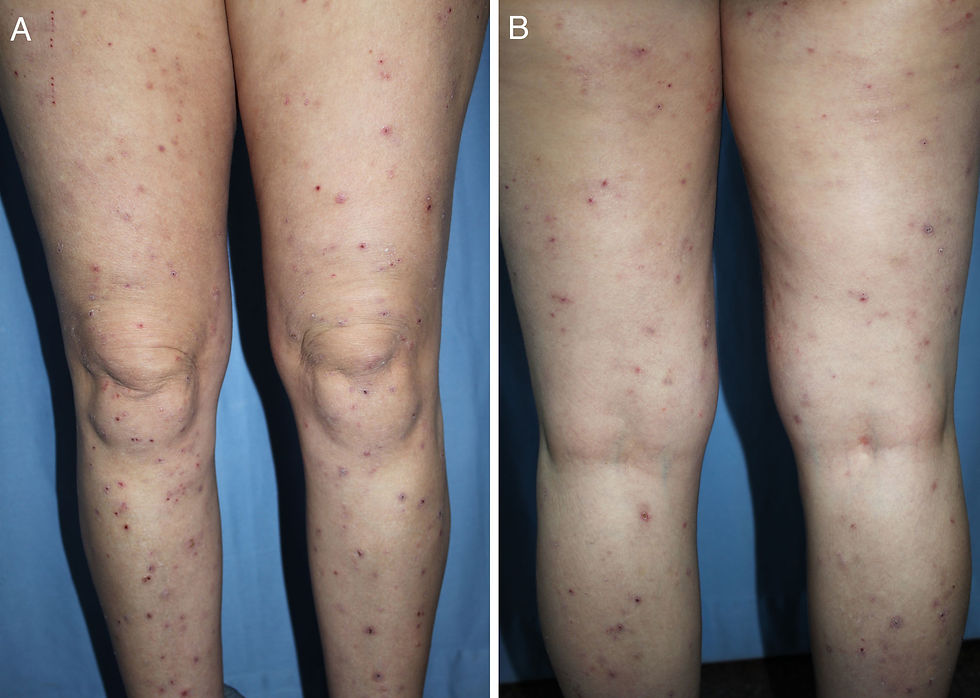
Prurigo simplex (subacute itchy bump rash) — very itchy small red bumps or tiny blisters that appear in crops and recur on the trunk and limbs, often scratched until a crust forms in the centre.

Actinic prurigo (itchy rash caused by sunlight) — chronic itchy bumps on sun-exposed areas such as the face, lips and arms, usually starting in childhood, and a type of photosensitivity condition.
Key point: all three are "itchy bumps", but what drives them differs. Nodularis is about the itch-scratch cycle and associated diseases, simplex is about triggers and allergy, and actinic is about sunlight. To treat them effectively, the correct type must be diagnosed and the underlying cause sought first.
What causes Prurigo nodularis (chronic itchy nodular rash)?
Prurigo nodularis is a condition in which the skin develops firm, raised nodules that itch intensely. There may be only a few or several dozen. They usually appear symmetrically on areas the hands can reach, such as the outer arms and legs, the back and the shoulders, while the middle of the upper back, which the hands cannot reach, is often spared (known as the butterfly sign).
The main mechanism is the itch-scratch cycle. Repeated scratching makes the sensory nerves and the skin thicken, which in turn makes the itch even worse, until the lesions become hard nodules that last for months or years.
What doctors want to emphasise is that Prurigo nodularis rarely appears on its own. It is often a sign that something is causing chronic itch, such as:
Other skin diseases, especially atopic dermatitis
Medical conditions such as chronic kidney disease, liver disease, thyroid disease, diabetes and iron-deficiency anaemia
Infections such as HIV, and in some cases it is associated with lymphoma
Nervous system and psychological factors such as stress and anxiety that lead to more scratching
For this reason, seeing a dermatologist is not only about treating the bumps you can see, but also about looking for the hidden cause.
How Prurigo nodularis is treated
The principle is to break the itch-scratch cycle and treat the underlying cause at the same time.
High-potency topical steroids, sometimes combined with occlusion to increase absorption
Intralesional steroid injection for stubborn nodules
Anti-itch medicines such as antihistamines and gabapentinoids, which help reduce neuropathic itch
Phototherapy for widespread disease
Biologics for moderate to severe cases — currently dupilumab (targets IL-4/IL-13), the first of this class to be approved, and nemolizumab (targets IL-31), which relieves itch quickly, according to the latest guideline (BAD 2025)
Treating associated conditions such as controlling eczema and managing kidney, liver or thyroid disease, which is essential for long-term improvement
What causes Prurigo simplex (subacute itchy bump rash)?
Prurigo simplex (also called subacute prurigo) is a rash of very itchy small red bumps or tiny blisters that appear in crops, spread symmetrically over the trunk, back and outer limbs. The bumps are often scratched open and crust over in the centre, then heal leaving dark marks or small scars, while new bumps keep appearing, coming and going over time.
Unlike nodularis, the bumps of simplex are usually smaller, not hard large nodules, and are more clearly linked to triggers such as:
Sensitive skin or allergy (atopy)
Hypersensitivity to insect bites (in some people a form of papular urticaria)
Stress and emotional factors
Certain medical conditions such as diabetes, liver disease or hormonal changes
How Prurigo simplex is treated
Topical steroids to reduce inflammation and itch of the bumps
Antihistamines to help control itch, especially at night
Avoiding and managing triggers such as preventing insect bites, keeping skin from becoming dry and managing stress
Looking for triggering medical conditions in people with chronic or treatment-resistant disease
What causes Actinic prurigo (itchy rash caused by sunlight)?
Actinic prurigo is a chronic photosensitivity condition (photodermatosis) that causes itchy bumps or nodules mainly on sun-exposed skin such as the face, nose bridge, cheeks, backs of the hands and arms. Symptoms usually start in childhood and continue chronically. A distinctive clue that helps tell it apart is involvement of the lips (cheilitis), especially a swollen, red, scaly lower lip, and some people also have conjunctivitis.
Actinic prurigo is linked to certain immune genes (HLA-DR4) and is common among Indigenous peoples of Latin America, but it also occurs in Asian people, including Thai people. It is often misdiagnosed because it is confused with PMLE (polymorphous light eruption), which is more common, usually seasonal and often clears on its own, unlike actinic prurigo, which lasts all year and is more chronic. It must also be distinguished from photocontact dermatitis and autoimmune diseases such as lupus.
How Actinic prurigo is treated
Strict sun protection is the most important foundation — broad-spectrum sunscreen, covering clothing, a wide-brimmed hat and avoiding midday sun
Topical steroids or topical immunomodulators to reduce inflammation of the rash
Oral medicines in severe cases such as thalidomide, which works well but must be used under close medical supervision because of serious side effects (absolutely not to be used in pregnancy), and other medicines as appropriate
Summary table: how to tell the three types of prurigo apart
Location: nodularis = outer arms and legs/back (sparing the middle of the back) · simplex = scattered over the trunk and limbs · actinic = only sun-exposed areas, including the lips and face
Appearance of the bumps: nodularis = large, firm, raised nodules · simplex = small bumps with a crust in the centre · actinic = itchy bumps/nodules on sun-exposed skin, often with cheilitis
Main trigger: nodularis = itch-scratch cycle + associated medical conditions · simplex = allergy/insect bites/stress · actinic = sunlight
Key clue: nodularis often has a hidden disease (kidney, liver, thyroid, HIV) · simplex comes and goes with triggers · actinic starts in childhood + lower lip inflammation
Why finding the hidden cause matters
What differs between treatment at a specialist clinic and buying a cream yourself is that a dermatologist does not stop at flattening the bumps but looks for why the itch is chronic, especially in Prurigo nodularis, where itching can be the first sign of kidney disease, liver disease, an abnormal thyroid, an infection or, in some people, lymphoma. A blood test and a systematic history are therefore part of treatment, not just choosing a cream.
When to see a dermatologist
Itchy bumps lasting more than several weeks, especially firm nodules that you scratch open repeatedly
Itching all over the body together with other symptoms such as weight loss, fatigue, night sweats, abnormal urination or yellow skin and eyes, which may point to a medical condition
An itchy rash only on sun-exposed areas or a chronically swollen, red, scaly lower lip
Self-treatment has not helped, or the rash keeps coming back, which often means the root cause has not been addressed
A rash in a child that itches chronically and appears on sun-exposed skin should be properly assessed to find the diagnosis
At Siam Dermatology, care for the prurigo group begins with clearly identifying the type, looking for the underlying cause, and then planning individual treatment, from breaking the itch-scratch cycle and topical and oral medicines to biologics where needed, delivered by a dermatologist.
Frequently asked questions about Prurigo
Can Prurigo nodularis be cured completely?
Many people improve or go into remission, but two things are needed together: seriously breaking the itch-scratch cycle and treating the underlying cause, such as eczema or a medical condition. In moderate to severe cases, biologics such as dupilumab and nemolizumab help control itch and flatten the nodules much better than was possible in the past.
How does Prurigo nodularis differ from Prurigo simplex?
Prurigo nodularis forms large, firm, raised nodules with severe itch, is chronic because of the itch-scratch cycle, and often comes with an associated medical condition. Prurigo simplex has smaller bumps with a crust in the centre that appear in crops and come and go, and is often linked to allergy, insect bites or stress. Telling them apart correctly helps choose the right treatment.
How does Actinic prurigo differ from ordinary sun rash (PMLE)?
PMLE (polymorphous light eruption) usually appears only at the start of the sunny season and gradually improves on its own. Actinic prurigo is chronic all year, usually starts in childhood, and is characterised by lower lip inflammation and, in some people, conjunctivitis. Telling the two apart requires a dermatologist and sometimes further tests.
Is the prurigo group contagious?
No. Prurigo nodularis, Prurigo simplex and Actinic prurigo are not caused by germs that spread from person to person, but by the skin's reaction to itch, triggers or sunlight. However, if a bacterial infection develops from scratching, that infection should be treated.
What should I do if the itch is so bad I cannot sleep?
See a dermatologist, because chronic itch that disturbs sleep usually means the condition is not yet controlled at its source. The doctor may use medicines for neuropathic itch, suitable topical treatment and a search for the hidden cause. Scratching for temporary relief makes the itch-scratch cycle worse and causes permanent scarring.
Written by Dr. Patara Voravutinon, Dermatologist · Last reviewed August 14, 2026

Comments